






Beyond Tech Support – How a Fractional CIO Drives Revenue and ROI
With a fractional CIO, you shift technology from a cost center to a growth engine by aligning IT strategy with sales, optimizing processes, and prioritizing investments that deliver measurable ROI; this expert helps you identify revenue-driving platforms, streamline customer experiences, and implement analytics that turn data into actionable opportunities so your technology decisions directly increase topline results and profitability.
Understanding the Role of a Fractional CIO
Definition of a Fractional CIO
A fractional CIO is a senior IT executive you engage on a part-time or fixed-term basis to provide strategic leadership without the full-time overhead; typical engagements run from 8-60 hours per month or on a retainer of $6,000-$25,000 monthly depending on scope. You get an experienced decision-maker who builds a technology roadmap, negotiates vendor contracts, designs security and data programs, and ties IT initiatives directly to revenue and margin objectives.
Engagement types vary: project-focused (cloud migration, SOC 2), interim leadership during a search, or ongoing advisory for 6-24 months. For example, companies often hire a fractional CIO for 3-9 months to lead a cloud rearchitecture and can see implementation velocity increase by 2-3x while keeping total cost 30-60% lower than hiring a permanent CIO plus supporting hires.
Difference Between Fractional CIO and Traditional CIO
A traditional CIO is typically a full-time executive accountable for long-term IT operations, compliance, and an entire IT headcount; fractional CIOs deliver targeted strategic outcomes with limited hours and a sharp focus on ROI. You should expect a full-time CIO to earn total compensation often in the $250,000-$400,000 range in midsize firms, whereas fractional engagements convert that expertise into predictable monthly fees and outcome-based deliverables.
Authority and scope also differ: fractional CIOs frequently report directly to the CEO or COO to rapidly align technology with business goals, without the burden of day-to-day IT hiring and people management unless contracted to do so. This model lets you access senior-level strategy-cloud cost optimization, M&A technical diligence, or product delivery acceleration-without expanding your org chart.
Choose a fractional CIO when you need measured, project-driven impact-such as accelerating time to market or reducing cloud costs by 20-40%-and a traditional CIO when you require continuous governance across a large, regulated environment or want an executive to build and own a permanent IT organization. In practice, startups with $5M-$50M ARR often use fractional CIOs to bridge growth phases; enterprises above that threshold usually move to a full-time CIO once sustained IT headcount and regulatory demands exceed what part-time oversight can reliably manage.
Key Responsibilities of a Fractional CIO
You should expect a fractional CIO to own the technology roadmap tied to business KPIs, prioritize initiatives that drive revenue or reduce costs, and deliver concrete artifacts-12-month roadmaps, 90-day action plans, vendor RFPs, and financial business cases. Typical responsibilities include cloud architecture and cost optimization, cybersecurity program design (policy, controls, vendor oversight), data and analytics strategy, and aligning product and engineering priorities to customer acquisition and retention metrics.
Beyond strategy, fractional CIOs often handle vendor negotiations (you can see 15-35% savings on large contracts), mentor existing IT leaders, set SLAs and performance metrics, and establish budgeting and procurement discipline. They also run technology due diligence for partnerships or M&A, where their part-time focus produces rapid recommendations and risk assessments within weeks rather than months.
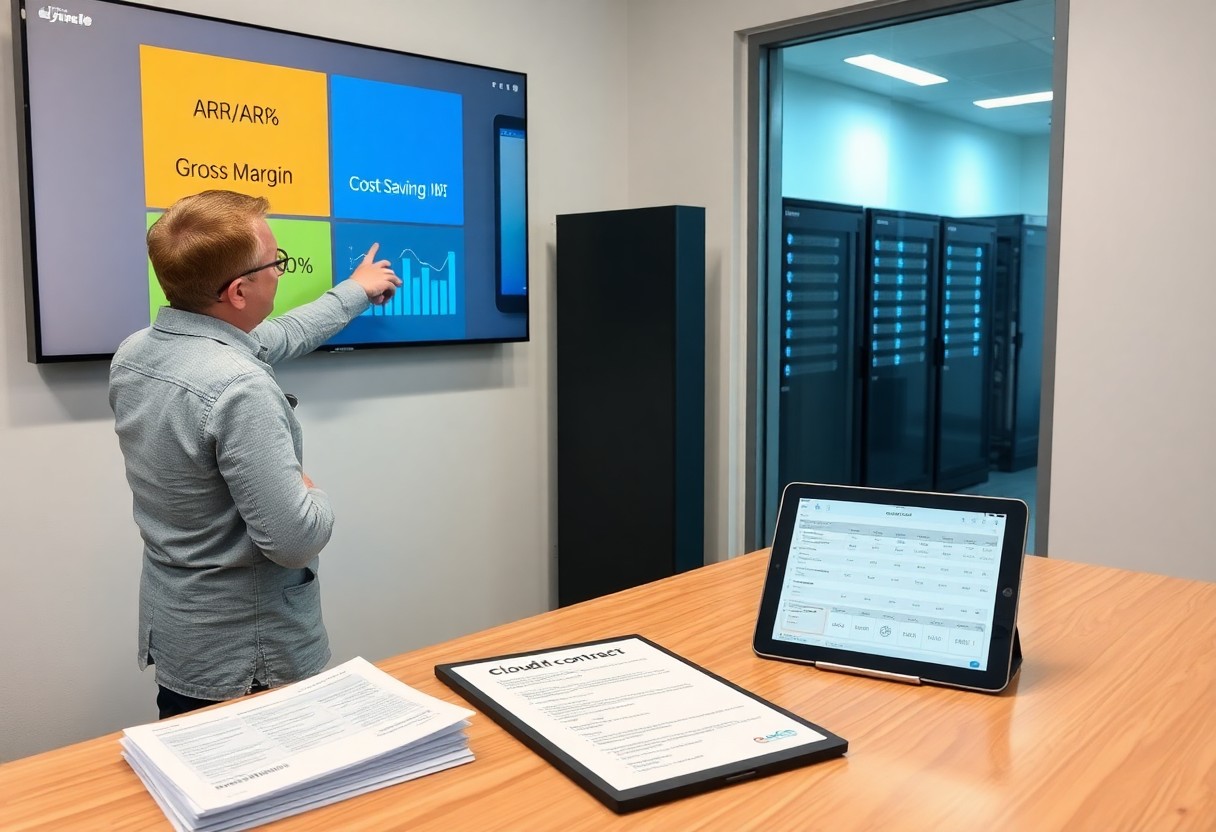
To measure value, your fractional CIO will define baseline metrics (e.g., deployment frequency, mean time to recovery, cloud spend per user, ARR growth) and deliver month-over-month reporting tying technology initiatives to business outcomes-so you can see, for example, a 40% reduction in MTTR, a 25% increase in deployment cadence, or a quantified improvement in gross margin within the first 6 months.
The Value Proposition of Fractional CIO Services
Cost-Effectiveness and Budget Optimization
You spend far less on strategic IT leadership while still getting senior-level outcomes: fractional CIO engagements commonly run $4,000-$15,000 per month depending on scope, versus a full-time CIO total compensation that often sits in the $180,000-$300,000+ annual range. That difference lets you redirect capital into product, sales, or marketing while funding a roadmap that drives measurable revenue.
Practical examples include consolidating duplicate SaaS subscriptions to cut software spend by 20-30%, renegotiating vendor contracts to lower recurring fees, and shifting capex to opex with cloud migrations that reduce infrastructure TCO by 30-50%. When you prioritize initiatives by short- and long-term ROI, a fractional CIO turns limited budgets into targeted investments that accelerate growth.
Access to Expertise Without Full-Time Commitment
You get direct access to seasoned CIO skills-architecture design, security programs (SOC 2, ISO, GDPR alignment), vendor selection, and product-IT alignment-without hiring a permanent executive. For example, a Series B SaaS company engaged a fractional CIO at 0.3 FTE and reached SOC 2 readiness in six months, unlocking a $2M enterprise contract it otherwise couldn’t pursue.
The engagement also accelerates internal capability-building: the fractional CIO establishes governance, mentors engineers and IT managers, and hands over playbooks so you retain knowledge. That approach reduces dependency over time while ensuring decisions are made with executive-level rigor from day one.
Engagement models vary-retainer, hourly advisory, or project-based-so you can pick a cadence that matches your cadence: predictable monthly spend for ongoing strategy, or concentrated bursts for specific initiatives like a cloud lift-and-shift or merger integration.
Flexibility and Scalability
You scale leadership up or down based on business cycles and strategic inflection points. During high-growth phases or M&A, a fractional CIO can ramp to near full-time to oversee integrations or platform re-architecture; afterward, you reduce to a part-time advisory role to maintain governance and roadmap alignment.
Real-world results include reducing time-to-market and integration timelines-one retailer cut a planned nine-month acquisition integration to five months by using a fractional CIO to prioritize API-first work and vendor coordination-saving both months of revenue leakage and sizable integration costs.
Typical arrangements range from 0.1 to 1.0 FTE-equivalents, with sprint-based deliverables and KPIs (time-to-deploy, cost-per-user, uptime). That structure lets you avoid lengthy executive searches (often 60-120 days) and the risk of a mis-hire, giving you immediate operational control and flexible ramping through trusted partner networks.
How a Fractional CIO Drives Revenue
Aligning Technology with Business Goals
You map every technology initiative to a revenue KPI – pipeline velocity, average deal size, conversion rate, lifetime value – and prioritize projects that move those needles fastest. A fractional CIO will build a one-page value case for each major investment showing expected lift (for example, a projected 10-20% increase in lead-to-opportunity conversion), implementation cost, and payback period, so you can see which projects generate revenue versus those that only reduce costs.
Governance is part of the work: you run quarterly tech-business reviews, tie the IT roadmap to OKRs, and use an outcomes dashboard to track progress. In one engagement, reprioritizing CRM enhancements and sales enablement integrations shortened the sales cycle by 24% and increased closed-won by 18% within nine months, because every change was measured against the commercial metric it was supposed to improve.
Implementing Revenue-Generating Technologies
You focus first on systems that have direct revenue impact: CRM and CPQ to speed quoting, marketing automation to lift qualified leads, e-commerce and subscription billing to capture transactions, and analytics/recommendation engines to increase AOV. The fractional CIO selects modular, API-first tools so you can deploy quickly and instrument impact; a typical approach is an MVP in 6-12 weeks followed by iterative rollouts tied to revenue KPIs.
Pilots and experiments are standard: you run A/B tests on channel workflows, pricing algorithms, or landing-page personalization and measure incremental revenue per channel. For example, a targeted personalization pilot increased average order value by 12% and paid for the underlying recommendation engine within eight months, because the deployment was scoped around clear conversion and AOV targets.
More implementation detail: you build the data plumbing up front – a customer 360 in a CDP or data warehouse, event tracking for behavioral signals, and near-real-time pipelines so personalization and dynamic pricing can act on live data. Expect initial integration work (ETL/streaming, identity resolution) to take 4-10 weeks, after which you can run automated experiments that scale revenue improvements across segments.
Enhancing Customer Experience Through Technology
You identify the high-leverage customer journeys that most affect retention and expansion – onboarding, first purchase, support resolution, and renewal – and apply technology to reduce friction and increase value. Tools like omnichannel support platforms, self-service portals, and in-app guidance often move the needle: deploying a self-service onboarding flow can cut time-to-first-value from weeks to days and lift renewal propensity by double digits.
Lifecycle orchestration matters for monetization: you automate trigger-based upsell and renewal campaigns based on product usage and health scores, and use AI routing to get customers to the right agent faster. In practice, orchestrating 3-5 high-priority journeys yields measurable results within 3-6 months – for instance, one client saw churn fall by 2 percentage points and NPS climb by 10 points after automating onboarding and proactive support notifications.
More on execution: start with instrumenting the journeys – session tracing, funnel conversion metrics, and churn indicators – then deploy lightweight ML models for personalization and next-best-action recommendations. Keep the scope focused (one journey at a time), use controlled rollouts, and quantify impact on LTV and churn so every CX improvement becomes a revenue lever you can justify and scale.
Measuring ROI with a Fractional CIO
Establishing Key Performance Indicators (KPIs)
You should define KPIs that map directly to revenue, margin, and cash metrics rather than IT outputs alone. Typical KPIs a fractional CIO will set include revenue growth rate (% change quarter-over-quarter), gross margin improvement (basis points), CAC (customer acquisition cost) and LTV:CAC ratio, ARR/MRR growth, churn rate (% monthly/annual), time-to-market (weeks), and IT spend as a percent of revenue. Assign baseline values during the first 30-60 days so you can quantify movement against initiatives.
Use targets and reporting cadence that reflect decision needs: monthly dashboards for operational KPIs (uptime, MTTR, deployment frequency) and quarterly for financial KPIs (ARR growth, margin lift, cost reductions). You should attribute improvements to specific initiatives with a simple scorecard that weights each project by expected EBITDA impact; for example, prioritize projects that deliver >$250K annualized benefit or a payback under 12 months.
Evaluating Technology Investments
You must evaluate technology bets with the same financial rigor you use for capital projects: calculate TCO across 3-5 years, projected cash flows, net present value (NPV), internal rate of return (IRR), and payback period. For instance, a cloud migration that reduces hosting and ops costs by 25% on a $400K annual spend yields roughly $100K annual savings; if migration costs $180K, your simple payback is 1.8 years and 3-year NPV at a 10% discount is positive. Those concrete numbers make trade-offs visible.
Model sensitivity and downside scenarios so you can present risk-adjusted ROI to the board. An ERP deployment costing $1.2M that reduces order-to-cash by 30% and lowers annual working capital needs by $400K can produce $600K in annual cash benefits; that translates to a 2-year payback and roughly 100% cumulative ROI at year two, assuming implementation milestones are met. Use milestone-based funding and pilot phases to reduce execution risk.
You should also factor in vendor economics, contract terms, and exit costs when judging investments. Negotiate caps on annual price increases, include performance SLAs tied to credits, and require a 90-day pilot with measurable KPIs (adoption >80% at 6 months, MTTR <1 hour, uptime 99.95%). Those clauses materially change the effective ROI and lower the probability of cost overruns.
Case Studies and Success Stories
You’ll see the value of a fractional CIO most clearly when numbers replace anecdotes. Typical outcomes include top-line increases via improved digital channels, margin expansion through process automation, and reduced capital outlays via cloud and vendor renegotiation. Many engagements return 2x-5x the initial investment within 18-36 months when tracked against the KPIs above.
Below are representative, anonymized case studies with measurable outcomes you can use as comparators for your business when planning investments and setting expectations.
- Regional retail chain (150 stores): $350K engagement to redesign omnichannel checkout; online conversion up 22% and average order value up 8% within 9 months; incremental annual revenue +$2.1M; payback = 2 months; 12‑month ROI ≈ 500%.
- Mid-market manufacturer: $980K ERP modernization program with phased rollout; order-to-cash cycle reduced 32%, inventory turns improved 18%, downtime cut 35% on key lines; annualized savings and working capital release = $1.1M; payback = 11 months; 24‑month IRR ≈ 60%.
- SaaS company (pre-IPO scale-up): 6-month fractional CIO engagement ($120K) to re-architect billing and onboarding; MRR growth accelerated from 6% to 12% monthly, churn down from 4.5% to 2.2%; annual recurring revenue uplift projected +$3.6M; cost to acquire new customers lowered 27%.
- Healthcare clinic network (12 sites): $210K program to consolidate patient portal and automate claims; claims denial rate fell from 14% to 5%, collections improved by $450K annually, patient throughput up 15%; regulatory audit readiness reduced potential exposure by $400K.
You can use these examples to benchmark expected timelines and ROI tiers for different project classes-digital revenue initiatives, enterprise system upgrades, cloud migrations, and compliance-driven automation each have distinct risk-return profiles. When you compare a proposed project against these baselines, you’ll be able to justify funding or re-sequence priorities based on where the highest EBITDA impact appears.
- Professional services firm (50 consultants): $95K investment to implement time-capture automation and e-billing; realization rate improved from 68% to 82% within 6 months; annual billed revenue up $620K; implementation payback = 2 months.
- Distribution business (multi-site): Cloud WMS migration costing $420K; picking accuracy improved from 93% to 99.4%, labor productivity +24%, storage footprint reduced 18%; annual savings and increased throughput = $1.05M; 18‑month ROI ≈ 150%.
- Financial services mid-market: Cybersecurity and zero-trust program ($310K) reduced average incident response time from 72 hours to under 4 hours, prevented a potential breach estimated at $2.5M exposure; insurance premiums lowered 14% annually after certification.
The Strategic Impact of a Fractional CIO
Transformational Leadership in IT
You get an immediate leader who translates business goals into an executable IT roadmap, not just a list of tickets. For example, a fractional CIO reorganized a 150-person services firm’s IT into product-aligned squads, replacing fragmented projects with three cross-functional teams and cutting project delivery time by 40% within nine months.
Beyond structure, your fractional CIO sets measurable KPIs-time to market, customer-impacting incident rates, and TCO per application-and enforces vendor consolidation and cloud rightsizing. A common result: a 15-25% reduction in annual IT spend through contract renegotiation and elimination of low-value tools while improving uptime from 97% to 99.9% for revenue-facing systems.
Fostering Innovation and Agility
You benefit from an innovation operating model designed to convert ideas into revenue quickly, using small, funded pilots with clear success metrics. In practice, a fractional CIO might launch three 90-day MVPs, scale the top performer that drove a 35% adoption lift, and add a new $400k ARR stream within 12-18 months.
They also instill delivery practices-CI/CD, feature flags, and telemetry-so you can iterate based on real user data instead of opinion. That shift commonly reduces feature lead time from quarters to weeks, enabling you to capture market windows faster and test monetization models with limited downside.
Operationally, you’ll see the fractional CIO define a lightweight governance cadence: monthly portfolio reviews, a prioritized innovation backlog tied to P&L, and explicit kill criteria for pilots-so scarce budget funds the experiments with highest ROI potential.
Risk Management and Cybersecurity
Your fractional CIO builds a risk-based security program that aligns controls to business impact rather than checklist compliance. For instance, they may deliver SOC 2 readiness in six months for a mid-market SaaS client by enforcing MFA, endpoint detection, and automated patching, cutting the vulnerability backlog from 450 to under 50 in 90 days.
They also quantify cyber risk for board-level decisions, translating technical exposure into potential revenue loss or remediation cost so you can prioritize spend. Typical outcomes include faster incident response (MTTR reduced from days to hours) and insurance-premium negotiation leverage after demonstrable control improvements.
Practically, you receive a repeatable process: asset inventory, third-party vendor assessments, quarterly tabletop exercises, and a measurable dashboard (mean time to detect, patch-cycle time, unpatched critical CVEs) that turns security from an expense into a risk-managed enabler of growth.
When to Consider Hiring a Fractional CIO
Signs Your Business Needs Fractional CIO Services
If your IT roadmap is reactive, projects slip past 6-9 month deadlines, or your product and sales teams are asking for technical prioritization you can’t deliver, you should consider a fractional CIO. You can often see measurable impact quickly: a 100- to 300-employee company typically achieves first major wins (cost savings, vendor renegotiation, or release cadence improvements) within 60-120 days under fractional leadership.
When hiring a full-time CIO would exceed your budget or timeline-common when annual revenue is between $5M and $100M-a fractional CIO gives you strategic leadership without the 90-180 day hire and six-figure fixed cost. You should also engage one during M&A, rapid scaling (30%+ YoY growth), or after a security incident when you need immediate governance and a prioritized recovery plan.
Comparing Fractional vs. Traditional CIO Engagements
Fractional CIOs deliver targeted strategy, vendor leverage, and short-term transformation while you retain flexible cost structure; traditional CIOs provide continuous organizational leadership, internal team building, and cultural change over multi-year horizons. You should weigh time-to-value against long-term embedding when deciding which model fits your stage and risk profile.
For example, a SaaS scale-up that needed a product-to-market realignment reduced churn by 12% within four months under a fractional CIO; conversely, an enterprise with 1,000+ employees justified a full-time CIO to manage a multi-year cloud transformation and a 24/7 operations model.
Comparing Fractional vs. Traditional CIO
| Fractional CIO | Traditional CIO |
|---|---|
| Lower recurring cost (often 20-60% of a full-time CIO), short ramp (30-60 days), engagement-based billing | Higher fixed cost (salary + benefits), long recruiting cycle (90-180 days), full-time onsite commitment |
| Focused on roadmap, vendor negotiation, quick ROI (30-120 days), measurable KPIs like uptime or release frequency | Responsible for long-term governance, internal team growth, cross-functional culture and multi-year programs |
| Best for SMBs, startups, or interim needs (M&A, crisis recovery, rapid scaling) | Best for large enterprises needing continuous presence, complex regulatory portfolios, or 24/7 operations |
| Scalable engagement-ramp up for 2-4 days/week or full-time sprints; easy to end or convert | Stable, embedded leadership-harder to replace quickly but better for sustained, organization-wide change |
If you’re evaluating both, assess three concrete metrics: time-to-value (weeks vs. months), total cost (projected 12-month outlay), and dependency risk (single-point reliance on an external contractor versus internal succession planning). You should opt for fractional when you need fast, measurable ROI or interim coverage, and choose a traditional CIO when you require continuous, embedded leadership tied to long-term culture and operational responsibility.
Industry-Specific Considerations
In regulated sectors like healthcare and finance you must prioritize compliance and audit-readiness; a fractional CIO with HITRUST, HIPAA, or PCI experience can harden controls and prepare evidence for audits within 90-180 days. In manufacturing or utilities, you should get someone familiar with OT security and vendor SLAs to reduce production downtime risk and integrate IT/OT roadmaps.
Retail and e-commerce businesses often need seasonal scalability and payments expertise-engage a fractional CIO before peak periods to optimize CDN, caching, and payment failover; SaaS providers should focus fractional support on SLA improvements (e.g., moving from 99.9% to 99.95% uptime) and release pipeline automation to cut rollback incidents by measurable percentages.
When you choose a fractional CIO for industry-specific needs, require documented domain experience, a 30/60/90 plan tied to compliance or uptime targets, and clear handoff criteria if you plan to transition to internal leadership later.
Summing up
From above you see that a fractional CIO does far more than resolve tickets: they align technology with revenue goals, prioritize investments that deliver measurable ROI, and create governance and KPIs that make your IT spend accountable to the business. By focusing on strategic initiatives-digital channels, data-driven decisioning, and vendor optimization-you accelerate time-to-value and turn technology into a predictable growth engine for your organization.
When you engage a fractional CIO, you get a senior leader who balances risk, cost, and innovation while mentoring your team to sustain improvements and capture long-term gains. For a concrete example of how this plays out in financial services, see The Strategic Edge: Leveraging fractional CIOs in credit …, which outlines practical ROI pathways and governance practices you can adopt.
